
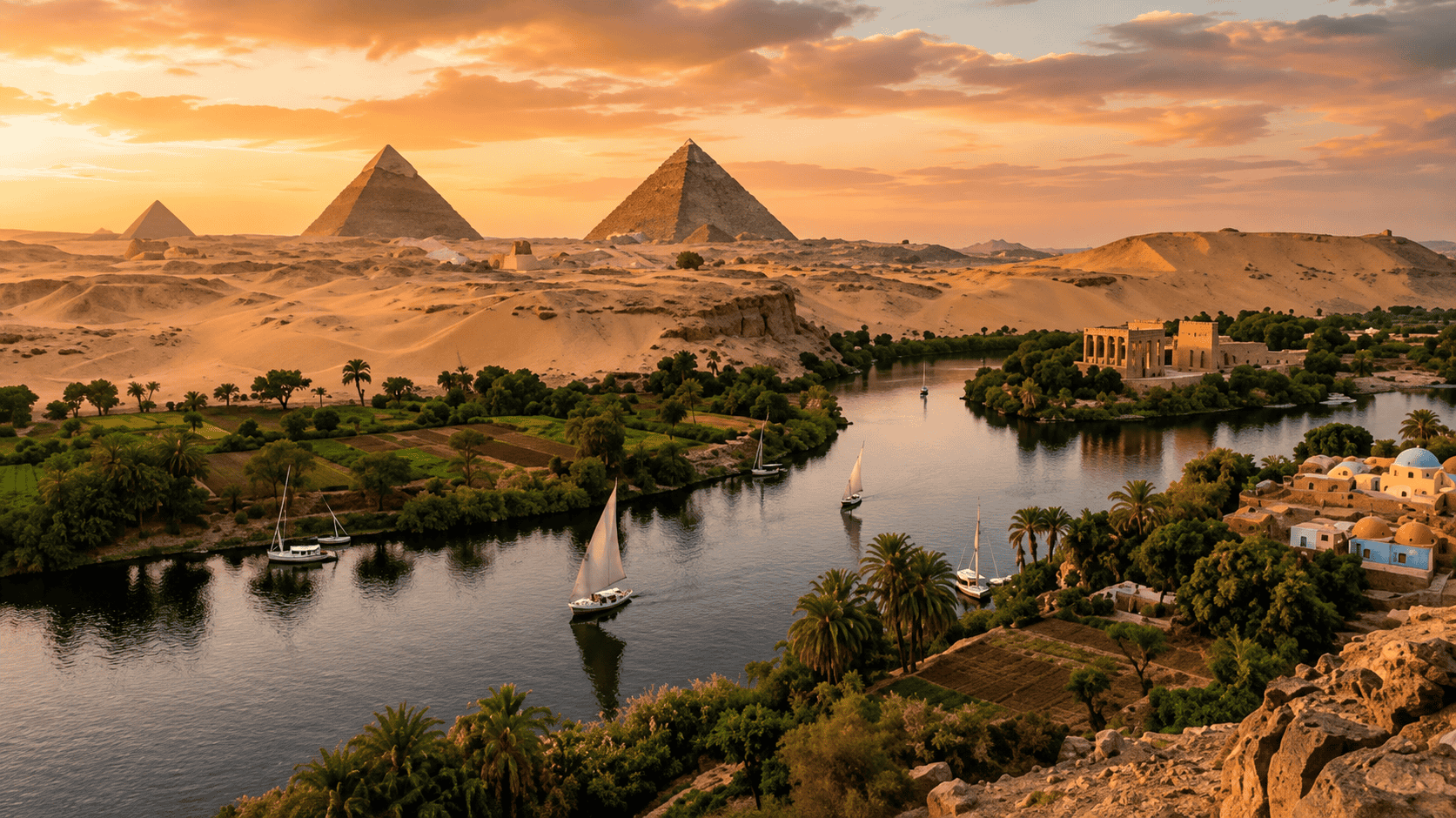
Egypt is home to some of the most iconic ancient sites on earth — the Pyramids of Giza, the Sphinx, and temples along the Nile that have stood for thousands of years. For travelers interested in history, few destinations offer as much depth in one trip.
Why Visit Egypt
- The Pyramids of Giza & the Sphinx — Among the last surviving Wonders of the Ancient World, and one of the most recognizable sights anywhere
- The Nile River — Cruises along the Nile connect many of Egypt’s most significant historical sites
- Ancient Temples — Luxor and Aswan are home to temple complexes like Karnak and Abu Simbel
- Red Sea Diving — Beyond the ancient history, Egypt’s Red Sea coast offers some of the world’s best diving
- A Deep, Layered History — From Pharaonic Egypt to Islamic Cairo, the country’s history spans thousands of years
Where to Go & What to See
Cairo and Giza are the natural starting point — the Pyramids of Giza (Khufu, Khafre, and Menkaure) and the Great Sphinx sit just outside the modern city, close enough that the pyramids are visible from parts of Cairo itself. The Egyptian Museum in Cairo (and the newer Grand Egyptian Museum near Giza) houses an extensive collection of artifacts, including material from Tutankhamun’s tomb. Islamic Cairo, with its centuries-old mosques, madrasas, and the sprawling Khan el-Khalili bazaar, offers a very different, more local side of the city.
Luxor, often called the world’s largest open-air museum, sits on the site of ancient Thebes and holds one of the densest concentrations of ancient monuments anywhere. Karnak Temple, a vast complex built and expanded over centuries, and the Valley of the Kings, where Tutankhamun’s tomb and dozens of other royal tombs were discovered, are the city’s major highlights, along with the Temple of Hatshepsut and Luxor Temple itself.
Aswan, further south along the Nile, is quieter than Luxor and serves as the gateway to Abu Simbel — the massive rock-cut temples built by Ramesses II, relocated in the 1960s to save them from flooding when the Aswan High Dam was built. Aswan is also a common starting or ending point for Nile cruises between the two cities.
The Red Sea coast, around Hurghada or Sharm El Sheikh, offers a very different kind of trip — beach resorts and some of the best diving and snorkeling in the world, often combined with the historical sites as a way to balance a culture-heavy itinerary with relaxation.
A classic Egypt itinerary combines Cairo/Giza with a Nile cruise or flight down to Luxor and Aswan, since most of the country’s most significant ancient sites are spread along this route.
Best Time to Visit
October to April is the most comfortable time to visit Egypt, with cooler temperatures suitable for exploring outdoor sites like the Pyramids and Luxor’s temples. Summer (June-August) can be extremely hot, particularly in Upper Egypt around Luxor and Aswan.
Why Travel to Egypt With TravoWay?
Covering Egypt’s ancient sites well means coordinating Nile travel, guides, and timing around the heat — details we take care of as part of your trip:
- Custom Itineraries — Cairo, a Nile cruise, and Red Sea time combined in a route that fits your interests and schedule
- Licensed Egyptologist Guides — Guides who bring the history of the Pyramids, Karnak, and the Valley of the Kings to life
- Nile Cruise Booking — Cabin arrangements on Luxor-Aswan cruises booked through operators we’ve worked with before
- Verified Hotels — Accommodation arranged through partners we’ve checked and worked with before, in Cairo and along the Nile
- 24/7 Support — We’re available throughout your trip for anything you need
Travel Tips
- Bangladeshi travelers need to apply for an Egyptian visa in advance — check current requirements before booking
- A Nile cruise between Luxor and Aswan is a popular way to see multiple ancient sites without extensive road travel
- Modest dress is appreciated, particularly when visiting mosques and more traditional areas
- Hiring a licensed guide at major sites like the Pyramids and Luxor’s temples adds significant historical context to the visit
How Long Should You Plan For?
A Cairo-only trip works well over 3-4 days, enough for the Pyramids, the Egyptian Museum, and Islamic Cairo. Adding a Nile cruise between Luxor and Aswan typically extends the trip to 8-9 days, since the cruise itself usually runs 3-4 nights. If Red Sea time is added as well, plan for at least 10-11 days total.
Interested in exploring ancient Egypt? Let us know your travel dates and interests, and we’ll help you plan the route.